
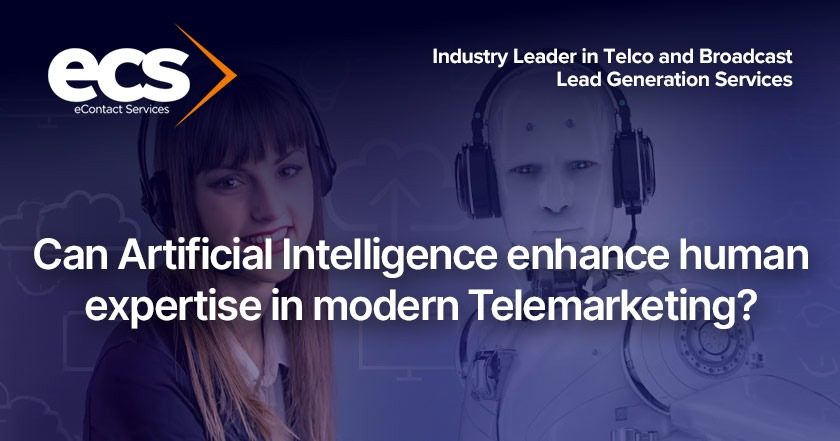
Many marketers are starting to harness Artificial Intelligence, finding roles for the technology within their strategies and campaigns.
Looking at how AI is being used is interesting, as is questioning its likely impact on marketing outcomes.
Conversations around AI, as we all know, are near endless right now but it’s not unreasonable to wonder where it will be used to maximum effect, and not simply seen as a panacea for all marketing ills. To make the point, let’s consider what are generally regarded as the leading uses of AI in marketing right now.
Hyper-personalization at scale
In these scenarios, AI analyses large volumes of customer data (behaviour, preferences, purchase history, etc.) to deliver personalized recommendations in real time—far beyond what manual segmentation could achieve.
Our view: From a telemarketing perspective, there can be little doubt that deploying AI in this way is and will be effective. The personalised recommendations that AI produces can easily be harnessed by competent and experienced telemarketers to maximum effect, increasing campaign ROI.
Predictive analytics for better decision-making
Machine learning models forecast customer behaviour—such as churn risk, lifetime value, or purchase intent—helping marketers optimize strategy, allocate budget more effectively, and target the right audiences at the right moment.
Our view: Again, AI used in this way is a telemarketer’s dream. Specific customer segments can be quickly, and accurately identified and proactive interventions can be immediately taken by a telemarketing team, for example calling identified churn risks on an ongoing basis thereby increasing the customer’s lifetime value.
Marketing automation and workflow optimization
AI powers automated email sequences, ad bidding, content scheduling, lead scoring, and customer service chatbots. This reduces manual workload and ensures faster, more consistent marketing execution.
Our view: Although less explicitly impactful on telemarketing, nevertheless AI can help smooth the complexities of multi-pronged campaigns of which telemarketing is one among many sources, but not the only one. It can also help quickly identify what sources are working and which aren’t, thereby identifying where and when the marketer should ramp activity.
AI-powered content creation
Generative AI creates ad copy, social media posts, product descriptions, images, videos, and even full campaigns. It accelerates production, enables rapid A/B testing, and supports creative teams with data-backed insights.
Our view: Possibly, but at what cost? When it’s crunching data, AI is both fast and accurate, desirable qualities in the context. But in creative tasks, less so. Furthermore, AI generated creative is easily distinguished from human generated creative. That’s why those who use AI for creative often find themselves re-editing it. AI may drive down the cost of the human creative, but it’s less than likely to supplant it. From a telemarketing perspective, the copy, scripts, and other communications required to support a campaign are unlikely to simply be outsourced to AI.
Enhanced customer insights through advanced analytics
Natural language processing (NLP) and sentiment analysis enable marketers to extract insights from reviews, social media comments, and conversations, improving brand monitoring and customer understanding.
Our view: A familiar theme is emerging here; yes, AI provides unrivalled insights at speed but…wait for it… you still need telemarketers to act on those insights.
Here’s the point, in summary. Is AI changing marketing? Yes. Is AI improving marketing? Yes, to a degree. The marketing church has always been a broad one, encompassing skills ranging from the analytical to the creative with many stops in between. In the more data and analysis-related realms, AI’s impact is dramatic.
Where human communication is required (on the phone, in words) less so. AI gives marketers a better idea of what to do. Humans, for the most part, still have to do it. Thus, for telemarketing, AI should provide a significant boost at the front end of campaigns, quickly helping to identify who to call, what to say to them, and what pain points need to be addressed. It’ll also help weed out those less likely to respond to an offer, thus in general terms increasing telemarketing’s ROI.
The winners will be the marketers (and telemarketing agencies) who learn how to use AI to its maximum effect.